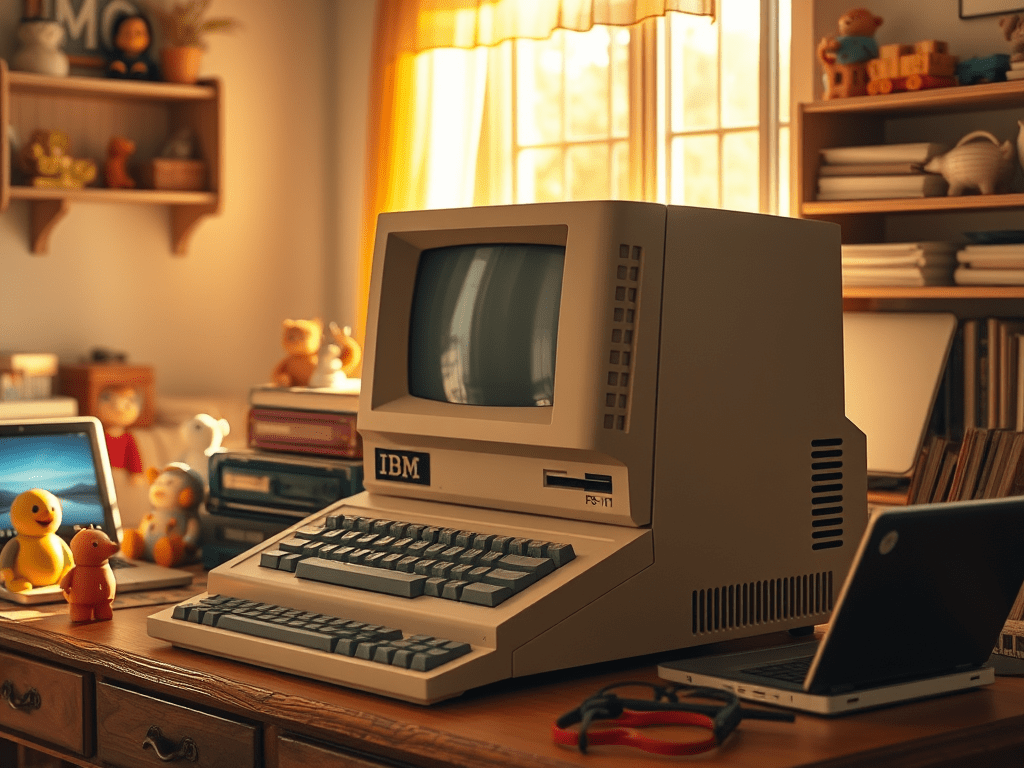
Do you remember your first computer?

My First Computer: From a Giant IBM in the 90s to My Son’s Chromebook Today
The memories of childhood often have a distinct, almost tactile quality. For me, one of the most vivid is the arrival of our family’s first IBM computer. It was the early 1990s. I was a kid born in the eighties. This machine seemed impossibly huge, a beige monolith that hummed with a mysterious energy. The whirring of its disk drive, the click-clack of the substantial keyboard, the glow of the monochrome (or was it early color?) screen – it was all utterly captivating. It wasn’t just a machine; it was a portal.
This portal was opened, in large part, thanks to my dad. A savvy engineer, he had graduated with a Master’s Degree from a top college in Monterrey, Mexico – Tecnológico de Monterrey. He was always fascinated by the latest technology, a trait likely honed at an institution that was itself a pioneer. Tec de Monterrey, for instance, acquired its first IBM computer, an IBM 1620, way back in 1963 and had integrated personal computers into all its majors by 1980. By 1989, it even boasted the first internet connection in Latin America.
So, when Dad would tell us stories of using advanced calculators for complex calculus during his college days, it wasn’t just a quaint anecdote; it was a glimpse into his early embrace of technological tools. His decision to bring an IBM PC into our home wasn’t just about acquiring a new gadget; it felt like a deliberate, thoughtful act, an extension of his own technologically progressive education and a desire to expose us, his children, to the future he saw unfolding. That “huge” computer, taking up significant space in our home, represented a substantial family investment, underscoring the value he placed on this emerging technology. It was a clear signal that something important had arrived. Little did I know then just how profoundly that humming box would shape my own path, leading me to a B.S. in Computer Technology, and how starkly it would contrast with the way I now navigate the tech world with my own son, born in 2022.
Decoding the 90s Behemoth: That First IBM and Its Peers
I can’t recall the exact model number of that first IBM – childhood memories are funny that way, latching onto the feeling more than the specifics. But it was undoubtedly a product of its time, a “state-of-the-art” machine for home use in the early 1990s . Thinking back, it was likely one of IBM’s PS/1 models, which were specifically designed for the home market.
These machines were a step towards making computers more accessible. For instance, the IBM PS/1 Model 2011, released around 1990, came with an Intel 80286 processor, typically 512KB or 1MB of RAM (expandable, of course!), and an optional 30MB or 40MB hard drive. A key feature of these early PS/1s was “DOS in ROM”. This meant the operating system, PC DOS 4.01, was built right in. For families new to computing, this was a big deal. It simplified the boot-up process, making the computer feel more like an appliance you could just turn on and use, rather than a complex piece of equipment requiring intricate setup. It lowered the intimidation factor significantly.
As the early 90s progressed, models like the PS/1 Model 2121 (released in 1992) offered more power with Intel 80386SX processors and around 2MB of RAM, while the PS/1 Model 2133 brought options for 80486 processors and could even run OS/2. While the PS/2 line was generally more business-focused, some lower-end models like the PS/2 Model 25-SX or Model 30 286 might have also found their way into homes.
Here’s a quick look at what some of those early 90s IBM home contenders offered:
| Model Name | Approx. Release Year | Typical CPU | Typical RAM | Typical HDD | Common OS |
|---|---|---|---|---|---|
| IBM PS/1 Model 2011 | 1990 | Intel 80286 @ 10 MHz | 512KB – 1MB | Optional 30-40MB | PC DOS 4.01 (in ROM) |
| IBM PS/1 Model 2121 | 1992 | Intel 80386SX @ 16-20 MHz | 2MB | 40MB – 160MB | PC DOS 4.01 (in ROM) |
| IBM PS/1 Model 2133 | 1992 | Intel 80386SX, 80486SX/DX series | 2MB – 16MB | 80MB – 253MB+ | PC DOS 4.01, OS/2 v2.1 |
| IBM PS/1 (Post-ROM) | 1993 | Intel 80386SX, 80486SX/DX series | 2MB – 64MB | Varied | PC DOS 6.00 / Windows 3.1 |
Data sourced from Home Computer Museum
The user experience back then was profoundly tactile. You’d physically insert a 5.25-inch floppy disk (a delicate square you hoped wouldn’t get dust on it) and listen to the drive churn and whir as it loaded a program. Storage was a precious commodity. A 30MB hard drive, if you had one, felt enormous, but software came on multiple floppies, and you were always conscious of disk space. This constant interaction with physical media, the careful management of kilobytes, fostered a very different understanding of data and resources compared to today’s seemingly limitless cloud storage.
PC DOS was the gatekeeper to this world, presenting you with a command prompt. Later, Windows 3.x started to appear, but for many, DOS was the primary interface. We used word processors like WordPerfect, maybe dabbled in spreadsheets, or played educational games. And the games! Titles like Lemmings or The Secret of Monkey Island offered pixelated adventures that sparked the imagination. There was no internet, at least not for most of us. In 1995, a staggering 99.96% of the world’s population did not have internet access. Our computer world was largely an offline, self-contained universe. This made my dad’s stories of advanced calculators even more resonant; he was working with cutting-edge computational tools, and now he was bringing a personal version of that computational power, albeit in a different form, right into our living room.
How a Box of Circuits Charted My Course: The Millennial Tech Awakening
That early IBM, for all its perceived limitations by today’s standards, was the spark. The lack of internet meant that exploration was focused inward, on the machine itself. There was a thrill in figuring out how to make a program run, a sense of magic in typing commands and seeing them executed. This wasn’t just passive consumption; it was active engagement, problem-solving, and discovery. I had a deep, foundational interaction with the machine’s logic and its potential for creation. This experience sparked my passion. That early curiosity, nurtured by a couple of hours spent with that beige box, directly paved the way for my decision to pursue a B.S. in Computer Technology. It turns out my experience isn’t unique; research consistently shows that early exposure to technology and STEM-related activities significantly boosts a child’s interest in pursuing careers in those fields.
I was born in the late 1980s. This places me squarely in the Millennial generation. More specifically, I belong to the “Xennial” micro-generation. This group experienced an “analog childhood and a digital young adulthood”. We remember a time before the internet was everywhere. However, we were young enough to adapt as it exploded into our lives. We’re a bridge generation, in a way. We recall the distinct symphony of a dial-up modem connecting. There was the painstaking process of downloading a single song. Perhaps some even engaged in the arcane art of tinkering with autoexec.bat and config.sys files to get a new game to work.
The computer was a destination, a specific tool for specific tasks, not the ever-present, multi-functional companion it is today. Learning was a different beast too. Without Google at our fingertips, knowledge came from thick paper manuals, trial and error, computer magazines, or tips shared between friends. This fostered a certain resourcefulness, a different kind of problem-solving skill. This dual experience, having one foot in the analog world and the other firmly planted in the digital, has given many Xennials a unique perspective. We didn’t just adopt technology; we witnessed its societal takeover, which perhaps makes us more reflective about its role in our lives and the lives of our children.
The Screen Time Seesaw: Navigating My Gen Alpha’s Digital World
Fast forward to today, and the technological landscape is almost unrecognizable. My son, born in 2022, is a true Generation Alpha. For him and his peers (born roughly between the early 2010s and mid-2020s), technology isn’t something novel; it’s an integral part of their environment from birth. They are the “iPhone generation,” the “AI generation,” for whom digital devices are often extensions of themselves, with many children using handheld devices before their first birthday.
His current device is a Chromebook, a popular choice for young kids, and for good reason. They are generally affordable, known for their simple operation, and boast robust security features like automatic updates and built-in virus protection. Their lightweight nature and integration with Google Workspace make them great for learning and collaboration. However, they’re not without drawbacks. Cheaper models can sometimes feel underpowered, storage is often limited (encouraging cloud reliance, which is a double-edged sword), and some budget-friendly options might lack backlit keyboards or essential ports like HDMI.
Parenting in this hyper-connected era brings a new set of responsibilities. To manage my son’s Chromebook usage, I rely on Google Family Link. It’s a suite of tools. It allows me to set daily screen time limits. I can also create “downtime” schedules to help him find a healthy balance. I can manage the apps he uses, approving or blocking them, and even set time limits for specific applications. Content filters are crucial for blocking inappropriate websites and managing permissions across Google services like Chrome, YouTube, and Search. While these tools offer a sense of control, they also change his early relationship with technology. This relationship shifts fundamentally compared to my own. My exploration of that first IBM was largely unmonitored. His, by contrast, is curated and observed. This isn’t inherently bad. The online world is far more complex and potentially perilous. But it does mean his perception of digital autonomy and privacy might develop differently. He’s growing up in an environment where digital spaces are often managed, which could shape his expectations in the long run.
The generational challenge is palpable. I, a Millennial, had to learn and adapt to the digital world as it emerged. My son, a Gen Alpha, is born into it, expecting immersive, personalized, and tech-driven experiences as the norm. He’s adept with touch screens and voice commands in a way that still sometimes astounds me. The baseline expectations are fundamentally different. Millennials might recall acquiring digital literacy; Gen Alpha assumes it and anticipates seamless digital integration in every facet of life. This presents a unique challenge. How do we meet these ingrained expectations? We also need to teach critical thinking about technology, digital citizenship, and the irreplaceable value of offline experiences. It’s ironic being a digital gatekeeper now. I experienced such unfettered freedom with that first, magical IBM, albeit offline.
The shift from that “huge” standalone IBM, with its precious local storage, to my son’s sleek, cloud-tethered Chromebook marks a significant transition.
It means more than just miniaturization. It illustrates a profound change. We are moving away from device-centric computing. The power was once in the box itself. Now, it’s about network-centric computing, where the connection to a vast universe of information and services holds the actual power.

Generations of Change, Constants of Connection
Looking back at that massive IBM in our living room is nostalgic. Now, I think about the slim Chromebook my son will soon master. It’s astounding to consider the velocity of technological change within a single lifetime. The beige box ran on floppy disks. It knew nothing of the internet. It seems like an artifact from a distant epoch compared to today’s always-on, cloud-connected devices.
Yet, despite the chasm of difference in the technology itself, some core human elements endure. The curiosity that drew me to that first PC is the same curiosity I see in my son’s eyes. He explores his world, digital or otherwise. The joy of discovery, the thrill of learning something new, the way technology can connect us – these are constants. Back then, “connection” might have meant the family gathered around that single computer, sharing an experience. Today, connection is global, instantaneous, and multifaceted, but the underlying human need for it remains.
My father introduced me to a new world of technology with an open door and an engineer’s enthusiasm. My role, as a parent in this era, has evolved. It’s now about guiding my child through a digital landscape that is far more pervasive and complex. I must balance the incredible opportunities for learning and connection with the need for protection and mindful engagement. The “savviness” my father embodied by bringing home that early PC has transformed. For my generation of parents, it’s about wise integration of these powerful tools. It also involves responsible stewardship.
It’s a continuous journey of embracing technological evolution while cherishing the foundational experiences of the past. The goal isn’t to resist the relentless march of progress. We aim to navigate it thoughtfully. We hope to instill timeless values in our children, regardless of the tools that define their generation. That first IBM did more than just teach me about computers. It taught me about the thrill of the new. It also taught me the power of curiosity. Additionally, I learned about the incredible ways technology can shape a life. And that’s a lesson I hope to pass on, in whatever form it takes, to my own son.


 Martha Cisneros Paja